Within the demanding realm of modern pro-level oversteer competition, success is not merely solely a product of sheer horsepower or pilot aggression. Instead, it has evolved into a multifaceted science that requires a meticulous marriage of choosing a time-tested vehicle platform, outfitting it with the most precise competition components, and, most essentially, grasping its dynamic characteristics on the track through sophisticated suspension tuning applications. This exhaustive manual functions as your roadmap from the very first idea of a project car through to the final engineering-refined adjustments that elevate a powerful car into a repeatable winner. We will examine in detail the precise engineering of chassis dynamics adjustment, showing how a modern drift tuning app like a dedicated telemetry system eradicates assumptions and provides exceptional insight into your vehicle's real-world dynamics.
The bedrock of any successful drift car is, undoubtedly, the platform itself. Certain platforms have achieved iconic standing within the worldwide oversteer community due to their natural weight distribution, robust construction, and the enormous ecosystem of aftermarket support available. Picking the right platform is the primary and most crucial choice a driver will make. For instance, the BMW E36 is universally acknowledged as perhaps the the greatest overall cars for drifting of all time. Its near-perfect 50/50 weight distribution, combined with a driven rear axle layout and bulletproof straight-six motors, establishes a car that is at once easy to handle for novices and extremely capable in the control of a expert competitor. The evolution of this philosophy, the BMW E46, builds upon these qualities with a more refined frame, increased stance for greater high-speed stability, and yet a greater degree of lock straight from the factory. A distinct powerful option in the pro arena is the Chevrolet Corvette C6.
This muscle-derived sports car offers a particular combination of strengths to the sideways discipline, featuring a low-mass aluminium chassis, a rear-mounted transaxle that aids in an perfect front-to-rear mass ratio, and the tremendous low-end power of a big LS V8 motor. This fusion renders it an complete force on track, designed of initiating and holding long slides with seemingly minimal use of throttle. For those desiring outstanding performance per dollar, the 350Z model Nissan excels as a top-tier candidate. It comes from the manufacturer with a stiff body structure, a competent OEM limited-slip differential, and the free-revving VQ35DE powerplant that provides plenty of power and torque for mastering and moving up in the sport. Its follow-up, the Nissan 370Z, presents additional advancements in structural rigidity, handling precision, and overall powerplant power, cementing its place as a favorite selection among professional competitors. Other iconic vehicles that warrant mention encompass the agile rotary-powered FC generation RX-7, the most popular Nissan S13 240SX, the torque-rich SN95 generation Mustang, the modern BMW E90, and the compact yet unbelievably fun and instructive Mazda MX-5. Every single one of these chassis provides a unique array of attributes, challenges, and possibilities, but they all share the basic elements essential to become a capable drift machine.
However, picking the optimal platform is just the starting point. To access the full performance of any of these vehicles, substantial modifications to the steering system and suspension systems are completely essential. This is where the world of performance aftermarket components comes into sharp view. The most most transformative modification for a serious drift machine is the installation of a high-performance steering angle kit. These engineered kits, such as those engineered by performance brands like SLR Speed, are engineered to significantly enhance the car's maximum steering angle. A standard street car is severely constrained in how far its tires can rotate, a engineering compromise for daily operation. In sliding, but, aggressive opposite lock is continuously required to control and hold a slide. An angle kit exchanges the OEM steering knuckles, tie rods, and potentially A-arms with parts that allow the steered wheels to reach angles over 70 or even 80 degs, compared to a normal stock setting of around 40 to 50 degs.
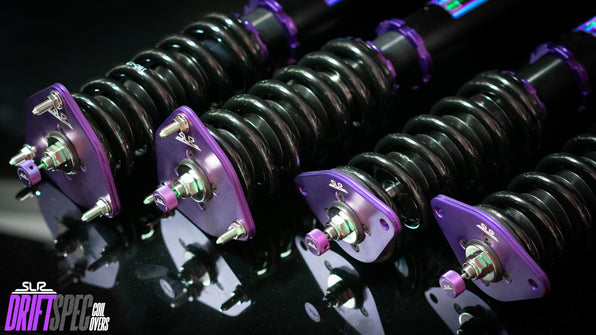
This vastly greater lock provides the pilot with exponentially enhanced command during a angle, allowing it to be far more straightforward to initiate a oversteer moment, sustain it through a sweeping corner, and change seamlessly from one side to the other. The improvement in controllability is truly transformative. Combined with a correctly selected steering kit is the equally vital enhancement to the car's suspension. Store-bought or including premium street dampers are simply not intended for the specific and extreme demands of competitive oversteer. A drift-spec set of suspension units is of utmost importance. These specific suspension components incorporate unique valving and spring strength that are optimized for the violent load shifting that is typical of drifting. When a pilot begins a angle, the vehicle's weight is transferred forcefully to the front of the corner. Optimal competition coilovers control this shift in a controllable way, allowing the car to find its balance quickly and giving the pilot accurate feel through the controls and seat. They additionally enable precise setting of ground clearance, shock absorber stiffness, and corner weighting, which are all key aspects of optimizing the chassis's behavior to a specific circuit or competition technique. In combination, a top-tier drift angle kit and a properly chosen pair of performance coilovers form the absolute mechanical base upon which all later optimization is constructed.
Once the fundamental components is in place, the subsequent essential stage in the project is the precise tuning of the vehicle's suspension geometry. This is the realm of chassis dynamics adjustment, a methodology that can appear intimidating to the newcomer but is, in practice, the defining factor to turning a set of capable pieces into a cohesive and controllable whole. The most debated parameter of suspension geometry for oversteer is definitely negative camber. Camber angle is the tilt of the tire in relation to the upright axis when viewed from the forward of the chassis. If the upper part of the wheel is tilted towards the car, this is called negative camber. In oversteer driving, an inward tilt on the front axle wheels is universally applied and is seen as necessary. The logic is fundamentally linked to tire contact.
When a car is turning at extreme angles, the frame leans towards the outer of the corner. This body roll causes the outside steering tire to diminish its ideal grip area with the asphalt. By introducing negative camber, the tire is pre-leaned to account for this roll. As the car leans into the bend, the outside front tire becomes more upright against the road surface, increasing its grip at the critical time when it is most required for steering authority. Commonly, front axle camber settings for a competition sliding vehicle fall between approximately -3 degrees to as extreme as -5 degrees or even greater, based on the specifics of the vehicle geometry, compound choice, and operator style. The rear tires also utilize inward lean, but the values are generally more conservative and subtler than the front axle. Overly aggressive inward lean at the back can make the car extremely loose and challenging to predict on power use, as it shrinks the effective tire footprint of the driven wheels during forward throttle application. Therefore, rear adjustments are commonly in the range of -1 degree to -3 degrees, finding a precise balance between offering adequate lateral grip to assist in entering and sustaining the slide while simultaneously preserving effective grip for exiting the bend. Camber is just one part of the more complex tuning picture, which also encompasses toe angle, self-centering steering, and bump steer correction.
Toe describes the direction of the tires when looked at from a bird's-eye view. Toe-in means the front edges of the wheels are closer together than the rear edges, while outward toe means the reverse. For sliding, a slight amount of front axle negative toe is commonly run to improve the initial handling reaction, making the vehicle feel more nimble and willing to start a drift. Rear toe setting is usually set to neutral or a extremely small amount of inward toe to encourage predictability under power. caster angle is the frontwards or backwards angle of the steering axis when viewed from the side of the vehicle. Positive caster enhances self-centering and stability solidity, and it additionally boosts inward lean gain during cornering, which is highly useful. Adjusting these values is a detailed interaction where a adjustment to one setting can and often will influence the other settings. The old-school method for dialing in a chassis's suspension geometry for sliding has long been a tedious endeavor of experimentation and feeling. A pilot or crew would make a modification based on intuition, test the car on track, depend on the pilot's subjective sensation and comments, and then make another adjustment. This process would iterate time after time until the chassis felt "right" or the scheduled practice session was exhausted. This methodology is not only exceptionally wasteful in terms of man-hours and tires, fuel, and parts, but it is additionally fundamentally imprecise.
Pilot sensation is a infamously inconsistent data source, affected by many variables such as fatigue, changing track grip levels, weather, and just the mood of the operator on that given session. What feels "oversteery" on one run might feel "understeery" on the following run, leading to confusing feedback and frustrating adjustments. This long-standing problem in vehicle dynamics optimization is exactly where modern technology has stepped in to transform the landscape.
The development and adoption of sophisticated vehicle dynamics tools suspension engineering has ushered in a new paradigm for tuning and refining high-performance drift cars. This new generation of tools, represented by innovative systems like data acquisition tools, operate by directly measuring the real-time physical performance of the chassis as it is piloted on the course. Unlike relying on personal impression, these systems collect objective data on key factors such as suspension travel, corner velocities, acceleration forces, lock position, and driver input position. This collected data stream is then interpreted by sophisticated algorithms that can graph and interpret the metrics in a actionable way. For the first time, tuners and builders can observe precisely what the vehicle is performing at any given millisecond of a slide. This capability changes the entire chassis setup process. Think about the particular goal of dialing in the front axle camber for a specific vehicle. Rather than introducing a change from -3 degrees to -3.5 degrees and then running multiple runs to try and "perceive" a difference, a vehicle dynamics tool can give instant and definitive feedback. The application can indicate graphically how the wheel's loading is behaving during the most important stages of a angle: initiation, sustain, and changing direction. It can demonstrate if the existing value is permitting the loaded tire to maintain optimal contact or if the tire is overloaded on its outer edge.
The tool can subsequently provide empirical suggestions for change. Perhaps the telemetry indicates that the tire is still stressing its edge at -3.5 degrees of camber, suggesting that even more negative camber, say -4 degrees, might be beneficial. Conversely, the information might reveal that the tread is failing to reaching optimal operating temp or that the inner shoulder is wearing unevenly, which could point to that there is overly aggressive inward lean and a small decrease back to -3.2 degrees would be more optimal. This standard of accuracy and actionable analysis was literally unimaginable in the time of solely mechanical adjustment.
The benefit of using a comprehensive drift telemetry system goes drift suspension tuning guide much further than just optimizing alignment. It becomes an essential suspension tuning guide that is tailored to your specific car. When fine-tuning the damping clickers on your coilovers, rather than relying on general advice or replicating another driver's settings, you can use the data to analyze how the car is performing in relation to your tweaks. The software can display the damper movement data over a run, revealing if the shocks are controlling the chassis motion properly or if they are causing the chassis to oscillate excessively after a flick. It can aid in diagnosing issues like bottoming out or excessive extension, enabling you to introduce informed choices to spring preload, rebound/compression rates, or stance. This process applies just as well to the intricate task of corner balancing. In addition to camber, the software can provide data into how changes to toe and caster angle are influencing the vehicle's handling during different phases of a lap. For instance, it can assist you to find the optimal amount of front axle toe out for your individual angle kit geometry and piloting style by measuring the quickness of turn-in reaction and the predictability of the vehicle at maximum lock. This turns the tool an extremely useful drift suspension tuning guide that is dynamically updated by the live performance of your own car on the track. It shifts the whole process from a subjective skill into a scientific development procedure.
Furthermore, the application of a tool like modern telemetry is in no way confined to expert tuners with large resources. For the club-level enthusiast, it serves as an incredible force multiplier. It effectively offers the builder with the insight of a vehicle dynamics tool professional dynamics engineer without needing the typical overhead. It drastically shortens the development time by delivering clear directions to problems that would otherwise take years of trial and error to understand. A builder can see how their particular vehicle reacts to different settings, developing a deeper understanding of suspension theory in the endeavor. It also opens up professional performance tuning principles, permitting anyone with the ambition to perfect their machine to accomplish it in a efficient and effective fashion. This is notably valuable in a activity like oversteer competition, where engineering know-how has historically been a closely guarded commodity among elite drivers. Now, that capability can be in the toolkit of every dedicated enthusiast.
In the final analysis, the journey to constructing and dialing in the ideal high-performance drift machine is a comprehensive project that seamlessly integrates time-honored hardware wisdom with 21st-century digital tools. It commences with the wise choice of a proven car, then enhanced by the installation of non-negotiable drift-spec components like maximum-angle angle modification systems and correctly selected performance adjustable dampers. The process then moves into the detailed phase of car suspension tuning, where values like camber angle, toe setting, and caster are precisely set to complement the car's new hardware and the pilot's personal technique. Finally, and what really distinguishes the modern process from the past, is the adoption of a powerful drift telemetry software. This platform eliminates the uncertainty and trial and error of purely feel-based tuning by giving quantifiable, actual telemetry on how the vehicle is truly performing. It functions as an incredible diagnostic aid, a definitive drift suspension tuning guide, and a master vehicle dynamics tool. In unison, this integrated approach guarantees that all aspect of the drift machine—from the choice of the car to the final tweak on the suspension—is optimized for maximum competitiveness on the track. It signifies the complete progression of the sport of drifting, merging physical pilot talent with precise suspension engineering to build the perfect dominant machines imaginable.